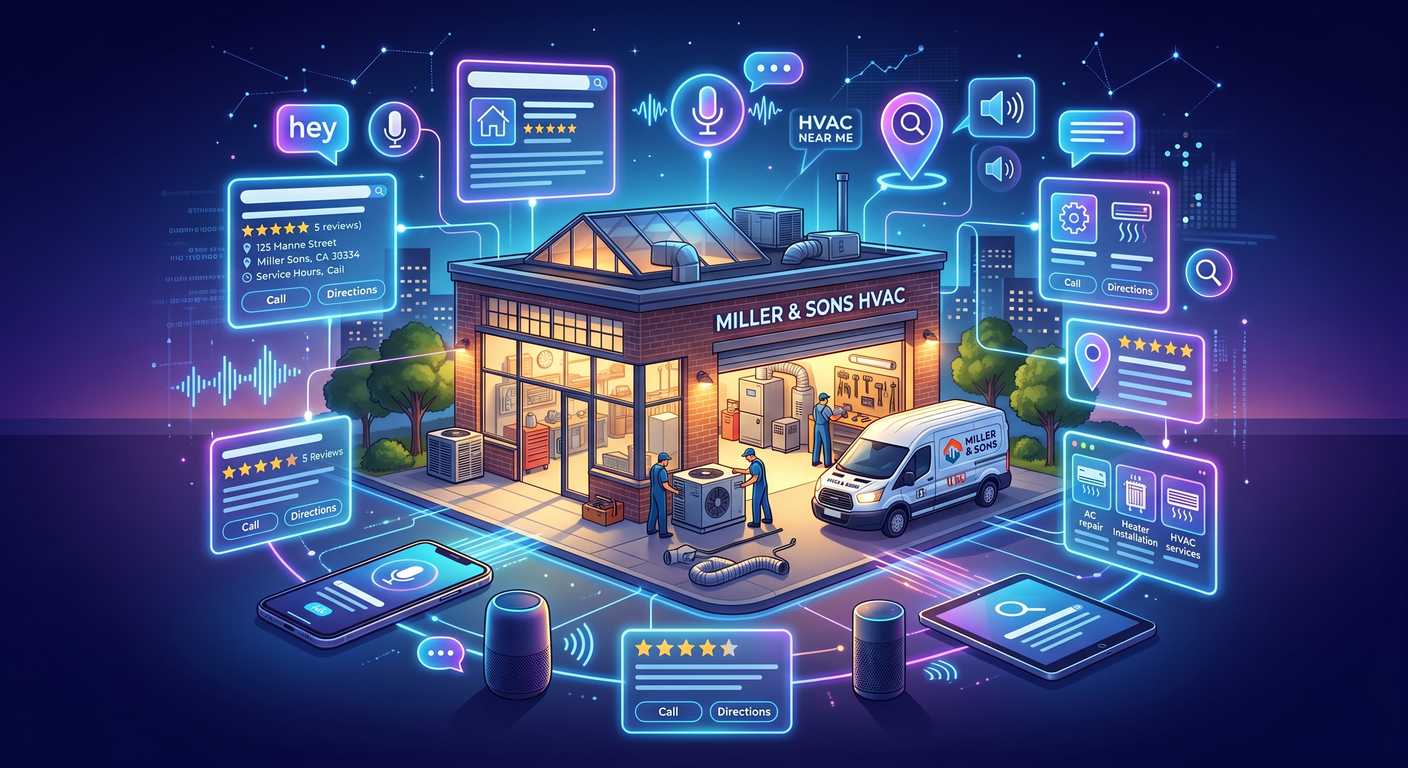
When someone in Tulsa needs a plumber at 9 PM on a Tuesday, they no longer open Google and type "plumber near me." They open ChatGPT, Siri, Gemini, or Perplexity and ask: "Who is the best emergency plumber in Tulsa that answers the phone right now?" The answer they get back is a list — usually three to five recommendations — and the names on that list are the ones that get the call.
If your shop isn't on that list, you didn't lose the customer to a competitor with better reviews or a lower price. You lost them to a competitor who understood how AI search works while you were still optimizing for the old rules. This is the new shape of local customer acquisition for HVAC and plumbing in 2026, and the small-operator playbook from 2018 isn't going to cut it.
The Numbers Behind the Shift
The data on consumer behavior change is sharper than most operators realize. Recent research on AI-assisted local search shows:
The shift isn't coming. It's here. In the last year, AI-recommended businesses in the home services space have seen a 4-7x increase in qualified inbound leads. The aggregate traffic to AI assistants for "find a [trade] near me" queries grew from a rounding error to over a third of all local-discovery traffic in twelve months. By the time most small HVAC and plumbing operators even hear about this trend, the AI-search-first customer will already be the majority of their market.
Why Small Operators Are Structurally Invisible
Here's the part the AI-search conversation usually glosses over: when a customer asks ChatGPT "who is the best HVAC company in Tulsa," the AI doesn't return the five closest Google Maps results. It returns the five businesses it has the most confidence recommending — and that confidence is built on a very specific stack of signals that small operators almost never have.
1. The AI Reads Your Web Footprint, Not Your Google Business Profile
Google's AI Overviews, ChatGPT, Perplexity, and Gemini pull from a fundamentally different corpus than Google's local pack. They're reading the actual content of your website — service pages, schema markup, FAQ structure, location pages, citation consistency, review velocity, and how your brand is described across authoritative third-party sites (BBB, Yelp, Angi, local directories, industry publications). A 1-truck operator with a one-page Wix site and a 4.6-star Google rating is functionally invisible to these systems. The national franchise with 200 location pages and 30,000 reviews across 40 directories shows up first.
2. Schema Markup Is the New SEO
Schema markup is structured data that tells an AI exactly what your business does, where you operate, what services you offer, and how to contact you. Most local HVAC and plumbing websites have none of it. National franchises have teams of developers who do nothing but maintain it. If your site doesn't tell the AI you're a 24/7 emergency plumber in Tulsa that serves 74114, 74133, and 74137, the AI won't recommend you when someone asks for one.
3. Review Volume Beats Review Score
A 4.6-star business with 47 reviews loses to a 4.4-star business with 4,700 reviews in AI search. The volume of reviews signals credibility and consistency in a way the AI weighs more heavily than average score. A solo operator who has earned every one of their 47 reviews personally is still at a structural disadvantage against a national brand whose review velocity is 12-15 new reviews per day, per location.
4. Content Velocity Matters
AI search engines reward businesses that produce authoritative content at volume. A national HVAC franchise publishes 50-100 service-area pages, 200+ blog posts, dozens of FAQ entries, and a steady stream of educational content every year. The 1-truck shop has a homepage and a "Services" page. The AI has nothing to recommend the small shop with — not because the small shop isn't good, but because the AI can't see the proof.
5. Brand Mentions Across the Open Web
When a local news outlet, an industry publication, or a community blog mentions your business by name with consistent NAP (name, address, phone) data, the AI learns that your brand is a real entity in its service area. Big franchises get these mentions for free through PR teams and franchise networks. Small operators get them only through deliberate reputation building — guest posts, sponsorships, local press,行业协会 membership, community involvement.
The Five-Question AI Visibility Audit
Here's a quick test any HVAC or plumbing owner can run right now to see where they actually stand:
- Ask ChatGPT, Gemini, and Perplexity: "Who is the best [your trade] company in [your city]?" If your business name isn't in the top 5 results on at least two of those three, you have a visibility problem.
- Ask the same tools: "What [your trade] company in [your city] offers 24/7 emergency service?" If your business isn't named, you're losing the high-value emergency work to whoever is.
- Google "[your trade] [your city] AI overview" or just search your main service term and look for the AI Overview box. If the AI Overview summarizes competitors and not you, you're invisible to Google's own AI as well.
- Check your Google Business Profile insights for "discovery searches" — these are the searches where customers found you without typing your business name. If the volume is dropping month over month while your review count climbs, your share of voice is shrinking.
- Run your website through Google's Rich Results Test at search.google.com/test/rich-results. If you get zero results, your site has no schema markup and the AI search engines have no structured data to recommend you on.
If three or more of those checks come back negative, the path forward is straightforward. It's not a six-month SEO campaign. It's a focused 90-day AI visibility build that any small operator can execute.
The 90-Day AI Visibility Playbook for Small HVAC & Plumbing Operators
Days 1-30: Build the Foundation
The first month is about giving the AI search engines something to work with. Without this foundation, everything else you do is invisible to the systems that matter most.
- Schema markup overhaul. Add LocalBusiness, HVACBusiness, Plumber, Service, FAQPage, and Review schema to every page of your site. If you use WordPress, plugins like Rank Math or Yoast handle this automatically. If you use a static site, your developer needs to write it by hand or use a schema generator.
- NAP consistency audit. Your business name, address, and phone number must be identical across every directory, citation, and listing on the web. Even small variations ("Tulsa OK" vs. "Tulsa, OK" vs. "Tulsa, Oklahoma") create ambiguity the AI interprets as multiple businesses.
- Google Business Profile optimization. Fill out every field. Add your service areas by ZIP code. Upload fresh photos weekly. Post Google Business updates twice a week. Answer every question in the Q&A section. The businesses that win local AI search have GBP profiles that are 10x more detailed than their competitors'.
- Build out your service-area pages. If you serve Tulsa, Broken Arrow, Owasso, Jenks, Bixby, and Sand Springs, you need a unique page on your site for each. Each page should describe the local service in detail, list common jobs in that area, mention local landmarks or neighborhoods, and include LocalBusiness schema with that specific geography. National franchises do this at scale; small operators can do it manually for their actual service area in 2-3 days.
Days 31-60: Build the Authority
Once the foundation is in place, the next phase is about giving the AI systems reasons to recommend you over a competitor. Authority is the difference between being on the list and being at the top of the list.
- Publish 8-12 high-quality educational articles answering the questions your customers actually ask. "Why is my AC blowing warm air?" "How do I prevent my pipes from freezing?" "When should I replace my furnace instead of repairing it?" Each article should be 800-1,200 words, structured with H2/H3 headers, include FAQ schema, and link back to your service pages. The AI search engines reward this kind of structured, question-answering content heavily.
- Launch a review-velocity campaign. The goal is 3-5 new Google reviews per week, every week, indefinitely. The businesses winning AI search have steady review velocity, not bursts. Automate the post-service review request via text, follow up with a phone call for unhappy customers before they post, and respond to every review within 24 hours. The AI weighs recency and responsiveness heavily.
- Get mentioned on third-party authoritative sites. Sponsor a Little League team, join the local chamber of commerce, write a guest post for a local real estate blog, get quoted in a Tulsa World article about HVAC scams, partner with a local realtor on a home-buying checklist. Every brand mention on a high-authority site is a signal to the AI that you're a legitimate local business. National franchises can't fake local authenticity; this is your structural advantage.
- Build out your FAQ content. Twenty to thirty FAQs on your site, each with FAQ schema, each answering a real customer question in plain language. The AI search engines pull FAQ content heavily when answering voice queries and conversational prompts. The more questions you answer authoritatively, the more often the AI cites you.
Days 61-90: Build the Moat
The last phase is about turning the AI visibility foundation into a compounding asset. This is where small operators start pulling away from the competition — not because of marketing spend, but because of accumulated structural advantage.
- Publish case studies. Three to five detailed case studies showing real customer problems you solved, with photos, technical details, and outcome data. Case studies with structured data markup become the AI's go-to citation when answering "is there an HVAC company in Tulsa that handles [specific problem]?" queries. National franchises publish generic case studies; yours can be specific, local, and authoritative.
- Launch a YouTube channel. Video content is the most under-utilized AI visibility lever for trades businesses. YouTube videos get indexed by Google, ChatGPT, Gemini, and Perplexity. A 5-minute video titled "How to Tell If Your AC Capacitor Is Bad — Tulsa HVAC Tech Explains" with proper titles, descriptions, and tags will rank in AI search within weeks and keep generating leads for years. You don't need a studio. A phone on a tripod and a clear walkthrough of the diagnosis is enough.
- Get your phone infrastructure ready for the AI-driven call volume. This is the part most operators miss. Even if your AI visibility work is flawless, the leads only convert if someone answers the phone when the AI-referred customer calls. Sixty-two percent of HVAC and plumbing calls go unanswered during business hours. The national franchises have call centers. You have an AI phone answering service that costs $200-$500 a month and handles every call 24/7. Pairing AI visibility work with 24/7 AI answering is the 1-2 punch that turns AI-driven discovery into booked revenue.
- Build a citation loop. Every new blog post, case study, or video should link back to your service pages, your Google Business Profile, your review profiles, and your key trust signals (licenses, certifications, insurance,行业协会 memberships). The AI search engines treat this kind of internal link structure as a strong signal of topical authority. National franchises have link-building teams. You have a content calendar and a checklist.
The Structural Advantage Small Operators Actually Have
Here's the part of the conversation the big-fanboy AI visibility consultants never tell you: small operators have advantages national franchises structurally cannot replicate. The franchise playbook works in Google Maps local pack because it was designed for Google Maps local pack. The AI search era rewards different things.
Authentic Local Knowledge
A Tulsa HVAC tech who grew up here knows what the 100°F weeks feel like in a 1970s ranch house in Midtown. A national franchise's location page talks about HVAC systems in generic terms. The AI search engines are getting better at detecting authentic local voice — and they reward it. Content written by someone who lives and works in your service area reads differently than content generated by a franchise content team in a different state.
Real Customer Relationships
The owner-operator who has been serving the same neighborhoods for 15 years has 15 years of relationship equity. A national franchise has a logo and a script. When you write a case study about Mrs. Johnson's frozen pipe emergency last January, the AI sees specificity, authenticity, and trust. When the franchise writes the same case study with names changed, the AI sees a template.
Local Authority Signals
The Little League sponsor, the church bulletin ad, the local news quote about the ice storm response — these are the signals the AI uses to verify you're a real part of the community. National franchises can't fake these. You can build them with deliberate, low-cost effort over 6-12 months.
Speed of Decision-Making
The national franchise needs six committees to approve a new service page. You can publish a new case study this afternoon. The AI rewards velocity, and small operators can out-ship the franchises on content velocity by an order of magnitude if they choose to.
What Happens If You Don't Act
The honest answer: nothing dramatic happens in the next 90 days. The AI-search-first customer is still a minority of total leads. But the trajectory is steep, and the gap between AI-visible and AI-invisible operators widens every quarter.
By the time the AI-search-first customer is the majority of your market in late 2027 or 2028, the operators who spent 2026 building their AI visibility will have a 2-3 year head start on content, citations, reviews, and authority signals. The catch-up cost will be substantially higher than the cost of acting now. This is a window, not a permanent opportunity. It closes faster than most operators expect.
"The discovery channel that mattered five years ago (Google Maps) still matters. But the discovery channel that will matter five years from now is AI assistants — and the operators who understand that today will own that channel for the next decade."
The Bottom Line
AI search visibility for small HVAC and plumbing operators in 2026 isn't about out-spending the national franchises. It's out-structuring them. National franchises have content teams, link builders, and PR agencies. You have the things the AI is starting to value more: authentic local expertise, real customer relationships, community authority, and the speed to ship content at a pace they can't match.
The playbook is straightforward: schema markup, NAP consistency, service-area pages, FAQ content, case studies, video, reviews, and brand mentions. Ninety days of focused execution puts a 1- to 5-truck shop ahead of most national franchises for AI-driven local discovery.
The next time a Tulsa homeowner asks ChatGPT "who is the best emergency plumber in 74114," your business can be on the list. The work to get there is a quarter of focused effort — and it starts today.
Get Your Free AI Visibility Audit
Quantum Agent Labs builds AI phone answering, lead capture, and AI visibility infrastructure for HVAC and plumbing businesses in Tulsa. We'll show you exactly where you stand in ChatGPT, Google AI Overviews, and Perplexity — and the specific 90-day plan to get your business into the top 3 AI recommendations for your service area.
Get Your Free AI Visibility Audit →