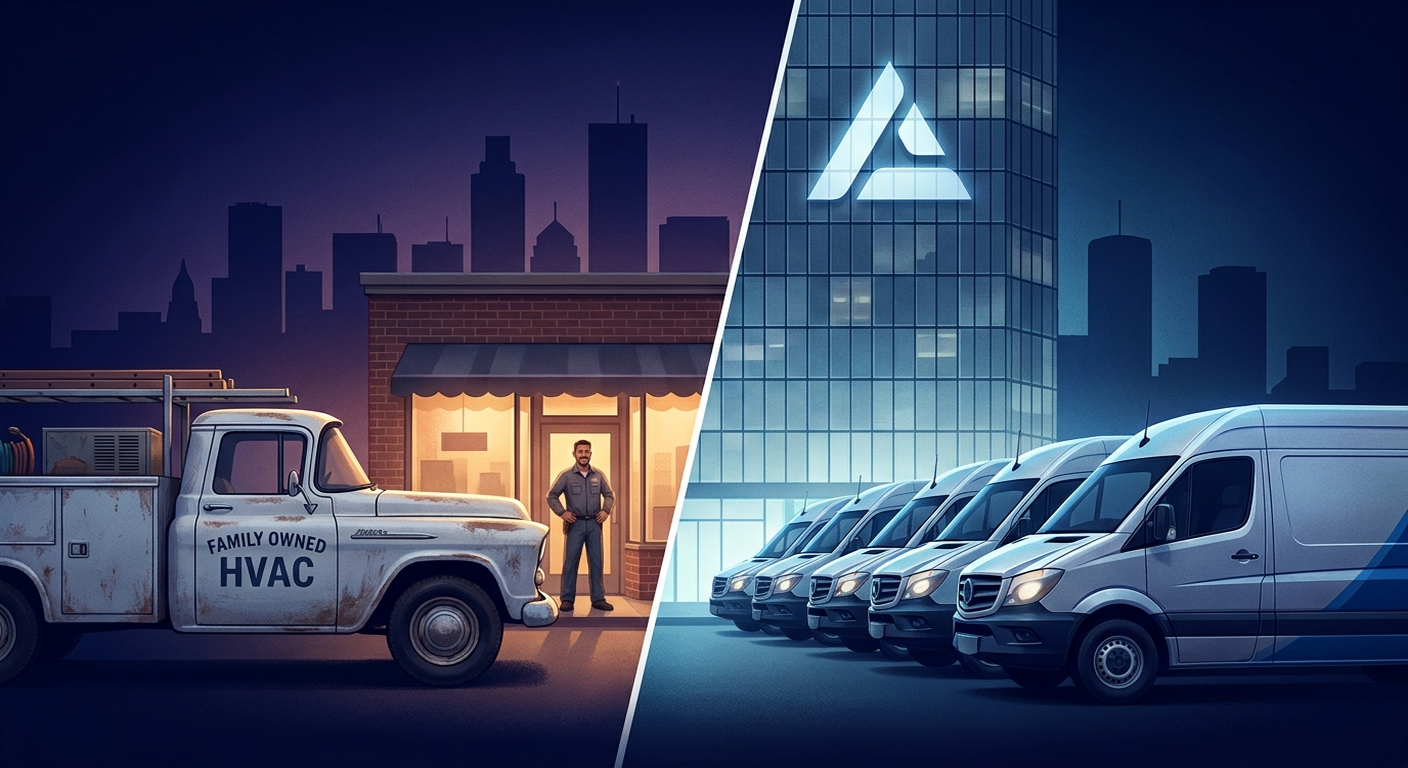
If you run a 1-to-5 truck HVAC or plumbing operation in the Tulsa metro, the ground just shifted under your feet. Over the last six months, three of the largest residential services consolidators in the country have made aggressive moves in northeast Oklahoma. The playbook is clear: roll up small operators, fold them into regional brands, and use scale to dominate local search, dispatch, and customer acquisition.
That doesn't mean small operators are doomed. It means the rules of competition just changed—and the owners who recognize it now will not only survive, they'll outperform the consolidators on the dimensions customers actually care about.
The Consolidation Wave Hitting Tulsa Right Now
Three deals in particular are reshaping the Tulsa market:
- Paschal Air, Plumbing & Electric acquired Robison Air in late 2025, marking Paschal's 11th location and bringing their full HVAC-plumbing-electrical bundle into the Tulsa metro for the first time.
- Rocket Group acquired Tulsa-based ProThermal Heating & Cooling, expanding their national footprint into northeast Oklahoma with deep operational resources.
- Service Experts launched its first franchise model in Tulsa with the rebranding of Jack Nelson Service Experts—essentially weaponizing franchise capital to roll up well-run shops.
And the acquisition pressure isn't slowing down. 62% of small business inbound calls go unanswered, according to 2026 industry data—and that's exactly the weakness consolidators exploit first. They walk in, show the owner their missed-call report, and offer a buyout that looks like salvation.
Why Small Operators Lose Without a Plan
Here's the brutal truth: when a national consolidator acquires a Tulsa HVAC company, they don't just buy the trucks and the customer list. They buy operational leverage that a 3-truck shop can't match on its own:
- Call center capacity: 24/7 answering with trained dispatchers in a different time zone.
- Marketing budget: Google Local Services Ads, geo-fenced campaigns, and SEO content teams.
- Buying power: Lower equipment and refrigerant costs through volume agreements.
- Technology stack: Field service software, customer portals, financing integrations—all pre-built.
Most small operators compete by being nicer, faster locally, and more flexible on price. Those advantages are real, but they're shrinking fast. A homeowner searching "AC repair near me" at 9 PM will probably call whoever shows up first in the AI overview—and if that's a national brand with a chat widget and an instant booking link, you didn't even get a chance.
"We're not going to out-spend Paschal or Service Experts on Google. So we have to out-answer them. Every call, every time, day or night. That's the only battleground we can win." — Tulsa HVAC owner with 4 trucks
The Counter-Strategy: Match the Big Boys Where It Matters
Small Tulsa operators have one structural advantage the consolidators can never replicate: local trust, owner involvement, and community presence. A Paschal technician in a branded van is still a stranger. You are the owner who coached little league, who fixed your neighbor's furnace for free last winter, who shows up personally when something goes wrong.
The strategy isn't to fight scale with sweat. It's to leverage AI and automation to match the consolidators' operational capacity, while keeping the local relationship advantages only you have.
1. Never Miss a Call — Even at 11 PM
This is the single highest-ROI move a small operator can make. Industry data shows AI phone answering can reduce missed calls by 75%. For a 3-truck operation booking $400 average tickets, recovering just 10 additional emergency calls per month at a 60% close rate is $24,000 in new annual revenue—for a service that costs a fraction of a human answering service.
When a Tulsa homeowner has a water heater flooding their garage at midnight, the consolidator's call center picks up. So should yours.
2. Show Up Instantly in Local Search
The "AI citation share" trend is real—homeowners are asking ChatGPT, Google AI Overviews, and voice assistants which HVAC company to call. The businesses that produce content answering questions like "best emergency plumber in Tulsa" or "AC repair Broken Arrow" are the ones getting recommended. A 3-truck shop can absolutely out-content the national brands for Tulsa-specific queries—and it costs almost nothing but time and AI tools.
3. Use 2026's Pricing Pressure to Your Advantage
HVAC equipment prices are rising across the board in 2026—driven by A2L refrigerant transitions, tariff pressure, and SEER2 efficiency mandates. The consolidators will pass those costs through with premium branding. You can compete on value and transparent pricing—a positioning that's increasingly rare and increasingly rewarded by homeowners tired of upsell scripts.
4. Capture the Replacement Demand Wave
2026 is a peak year for HVAC replacement demand—systems installed in the mid-2000s are hitting end-of-life. A standard Tulsa residential AC replacement runs $6,500–$12,500; full system replacements hit $9,500–$16,000. That's high-ticket work where the consolidators' call center can route the lead to whichever region has the highest margin. You can be the local owner who answers personally, follows up the same day, and closes the deal without the lead ever leaving Tulsa.
What Smart Small Operators Are Doing This Quarter
If you're a 1-to-10 truck HVAC or plumbing operator in the Tulsa metro, here's what the next 90 days should look like:
- Audit your missed calls. Pull the last 30 days. How many went to voicemail after hours? How many rang busy during a job? That's your baseline leak.
- Deploy 24/7 AI call answering. The technology is mature, affordable, and integrates with most field service software. This is the single biggest competitive equalizer available to small operators in 2026.
- Double down on local SEO and AI search visibility. Get your Google Business Profile perfect. Start publishing Tulsa-specific content monthly. Get listed in the AI Overviews and voice search results.
- Build a customer reactivation list. You probably have hundreds of past customers who haven't heard from you in 12+ months. A simple seasonal email or SMS campaign is a 5x ROI play.
- Stop trying to outscale the consolidators on trucks. Compete on responsiveness, local trust, and service quality—and let automation handle the rest.
The Bottom Line
Tulsa's HVAC and plumbing market is in the middle of the most significant consolidation in a generation. The big players are well-funded, well-staffed, and well-prepared. But consolidation doesn't eliminate small operators—it just forces a sharper strategy.
The owners who will thrive in 2026 and beyond are the ones who treat this moment as a wake-up call. Modernize the phone system. Capture every call. Build a digital presence the consolidators can't out-spend locally. Lean into the owner-operated advantage that no PE rollup can replicate.
Consolidation is inevitable. Becoming a casualty is not.