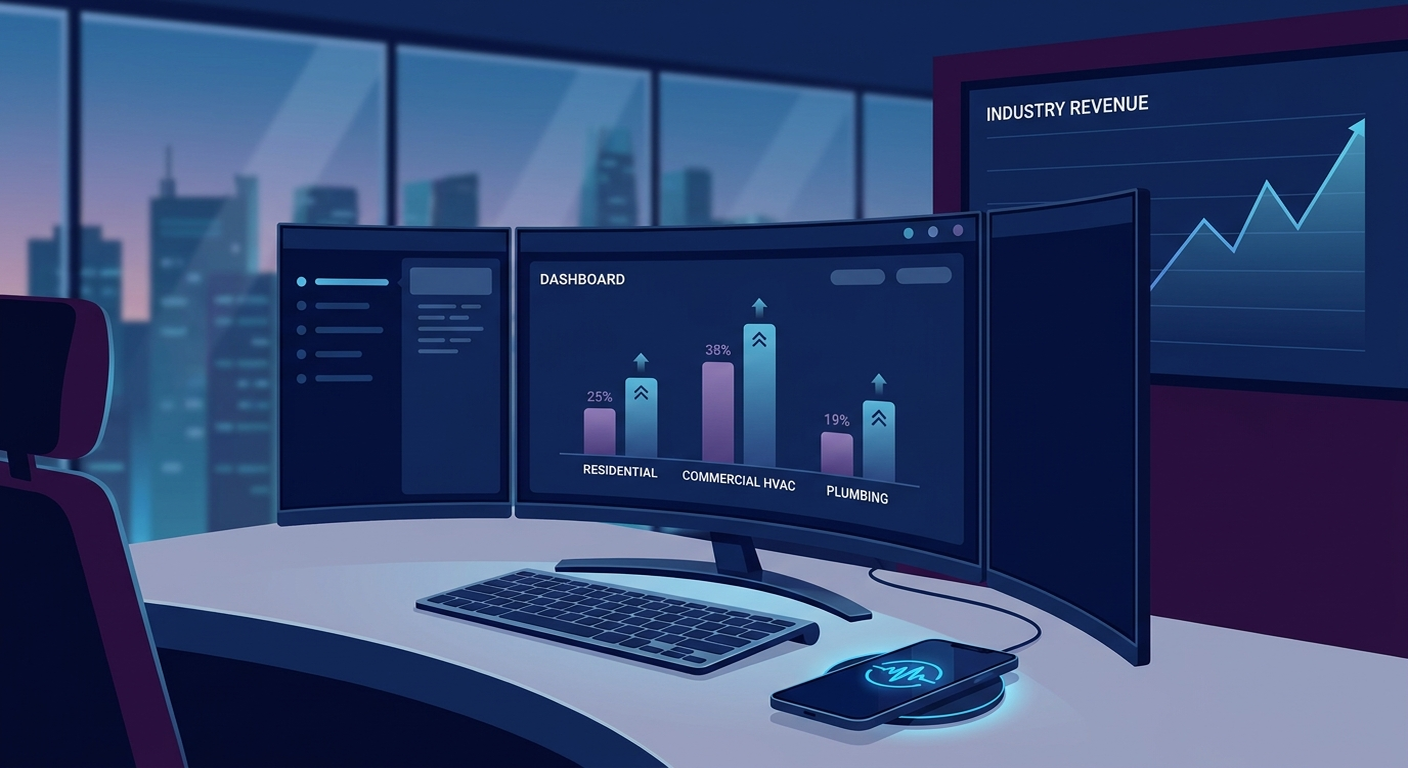
Every July, the trades industry publishes its annual AI adoption benchmarks. This year's numbers are the most important data set small HVAC and plumbing operators have ever seen, because they confirm two things at once: AI is now standard practice for a meaningful slice of the industry, and the gap between operators who use it and operators who don't is widening faster than at any point in the last decade.
For a 3- to 10-truck HVAC or plumbing business in Tulsa, Oklahoma City, or anywhere in the broader trades market, these numbers are the new baseline. They tell you how your business stacks up against the field — and they tell you, with surprising precision, how much revenue you're leaving on the table if you haven't moved yet. Let's walk through the data.
The Headline Numbers: 2026 AI Adoption in HVAC & Plumbing
The most consistent 2026 industry surveys — from Housecall Pro, ACHR News, Pipeline Onion, ServiceTitan's contractor panels, and Meticulous Research — converge on a similar story with slightly different cuts:
Those four numbers are the spine of the 2026 story. Let's unpack what they mean for small operators — because averages hide the variance, and the variance is where the real money is.
Why the Residential HVAC Gap Is the Most Important Number on the Board
The most striking 2026 data point is the split between awareness and adoption in residential HVAC. 74% of residential contractors say AI could be beneficial to their business — but only 25% actually use it. That's a 49-point gap between "I get it" and "I'm doing it." For a single trade vertical, that's an enormous delta.
That gap is the single largest under-served market in the 2026 AI trades economy. Every residential HVAC operator sitting in that 49-point gap is essentially saying, out loud, that they see the value and have not captured it. The operators who close that gap first in their local market — Tulsa, OKC, Springfield, Fayetteville, Wichita, Kansas City — will own the next 18 months of customer acquisition in their service area.
Why has adoption lagged awareness? Three reasons the data keeps surfacing:
- Implementation friction. Most small operators don't have IT staff, don't have a vendor relationship with an AI provider, and don't have time to evaluate platforms. The "I should do this" stays theoretical for months because the operational lift to start feels bigger than the benefit.
- Bad prior experience. The 2022–2023 wave of cheap chatbots and IVR menus gave many operators a bad first taste of "AI" that was actually just a worse voicemail. The 2026 models are dramatically better, but the memory of the bad first attempt lingers.
- Unclear ROI math. Most operators can quote their monthly phone bill, their dispatcher salary, and their average ticket. They can't easily translate "AI phone agent" into a clear monthly P&L line. The 2026 surveys show that operators who do the math convert at 3–5x the rate of operators who don't.
For a small residential HVAC operator in Tulsa, the math is actually simpler than the surveys make it sound. We'll get to that in a minute.
Commercial HVAC: Where the 38% Means Real Money
Commercial HVAC is the segment where 2026 AI adoption is most advanced — and the segment where the operators using AI are pulling away from the rest of the pack. 38% of commercial HVAC contractors now report measurable business impact from AI, up from 17% in 2025. That's a 21-point year-over-year jump, and it tracks with the broader commercial services market, where AI is being deployed in three primary categories:
- Predictive maintenance and diagnostics. AI monitors vibration patterns, amp draws, refrigerant pressures, and temperature curves to predict equipment failure weeks in advance. The commercial ROI on this is enormous because the cost of a single failed chiller in a high-rise office tower runs $50,000–$200,000 in lost tenant productivity, emergency parts, and overtime labor. Catching that failure two weeks early is the difference between a planned Tuesday morning swap and a 2 AM emergency call.
- Adaptive HVAC control. AI-driven building automation systems (BAS) integrate weather feeds, electricity prices, occupancy data, and CO2 levels to "pre-condition" zones and shift load to off-peak hours. The industry data shows 25–35% energy savings on commercial HVAC systems running adaptive AI control. For a building spending $400,000 a year on HVAC, that's $100,000+ in annual savings — often enough to fund the entire AI deployment in year one.
- Service call triage and dispatch. Commercial HVAC customers expect 24/7 response. AI phone agents handle the after-hours overflow, qualify the issue (is this a refrigerant leak or a thermostat calibration?), and dispatch the right tech with the right parts. The same dynamic is playing out in commercial plumbing and commercial electrical — but HVAC is leading the adoption curve.
For a residential operator reading this, the commercial data point is important as a leading indicator. The commercial market is generally 12–18 months ahead of residential in technology adoption. When 38% of commercial HVAC contractors see measurable AI impact, residential is 12–18 months from the same inflection point.
Plumbing: The Quietest AI Adoption Story of 2026
Plumbing's jump from 7% AI adoption in 2024 to 19% in 2026 is the most dramatic vertical movement in the 2026 data — a near-tripling in two years. Plumbing operators have historically been the slowest trade to adopt new technology (the joke is that plumbers still use paper invoices because the water hasn't gotten the new software wet yet), but the 2026 numbers show a clear inflection point.
What's driving the plumbing jump? Three things:
- Missed-call economics are brutal in plumbing. Plumbing emergencies (burst pipes, sewer backups, water heater failures) are time-sensitive in a way HVAC emergencies aren't. A homeowner with a burst pipe at 11 PM is going to call the first plumber who picks up — and 85% of voicemail callers will not leave a message. The cost of a single missed plumbing emergency call is $1,200–$4,500. The math forces adoption faster than any tech trend report could.
- AI phone agents handle the triage plumbing needs. "Is this a leak, a clog, or a water heater failure?" is exactly the kind of structured triage AI handles well. The bot can identify the issue, ask if water is actively flowing or contained, capture the address, and dispatch the on-call plumber — all without a human dispatcher touching the call. For a 2-truck plumbing operation, that's the difference between sleeping through emergencies and capturing them.
- Plumbing is more dispatch-driven than HVAC. HVAC has a larger install/replacement revenue line that doesn't depend on phone call capture. Plumbing is more service-and-repair, which means more phone-dependent revenue. That structural difference makes the ROI on AI call capture faster for plumbing than for HVAC, and operators are catching on.
The "48% Daily Use" Stat — What It Actually Means
The 48% figure for daily AI use across trades professionals is the most-quoted and least-understood number in the 2026 surveys. Most of that 48% is office staff and management using AI for things like email drafting, marketing copy, proposal writing, scheduling, and customer follow-up — not techs in the field using AI to diagnose equipment. Only a small slice of that 48% is doing the kind of integrated AI phone agent / scheduling / dispatch work that moves the revenue needle.
This distinction matters because it tells you where the operators in the data are. The 48% number includes everyone from "I use ChatGPT to write my monthly newsletter" to "I have an AI phone agent that books $40K/month in emergency calls." Both count. They are not the same thing, and they don't deliver the same ROI.
The 31% of trades professionals who report an "immediate ROI" from AI in 2026 are almost all in the second category — operators who deployed integrated AI tools (phone, scheduling, dispatch, lead nurture) that show up in the revenue line within the first 60–90 days. The 17% who use AI but don't see immediate ROI are mostly in the first category — using AI for productivity but not for revenue capture.
For a small operator trying to figure out which bucket to land in, the answer is straightforward: deploy AI where it touches revenue first (phone, scheduling, lead capture), then layer in productivity AI (email, proposals, marketing) once the revenue line is moving.
The 2026 Math: What AI Adoption Actually Looks Like for a 3-Truck Tulsa Operator
Let's get specific. For a 3-truck HVAC operation in the Tulsa metro doing roughly $1.2M in annual revenue, the 2026 AI adoption data translates to a clear benchmark:
If that 3-truck Tulsa operation is in the 25% of residential HVAC contractors using AI tools (and specifically an AI phone agent), they're capturing an additional 15–25 jobs per month — jobs that previously went to voicemail during the 4 PM to 9 PM surge. At an average ticket of $450 for residential HVAC, that's $6,750–$11,250 in additional monthly revenue, or $81,000–$135,000 over a year.
For the same operation that isn't in the 25% — the 75% of residential HVAC operators still using voicemail, answering service, or just a busy dispatcher — the math is inverted. They're losing $45,600 a year on average to missed calls, with the top quartile of that loss hitting $189,000+ per year. And they're losing customers to the operators who picked up the phone.
This is what the "gap" means in real money. It's not a vibe shift. It's a six-figure revenue shift for an operation of this size.
What the 74% Who "Could" Are Waiting For
The 74% of residential HVAC operators who believe AI could be beneficial but haven't adopted it yet represent the single biggest near-term opportunity in the trades. The 2026 surveys are explicit about why this group hasn't moved:
- 36% say they don't have time to evaluate platforms. The "I'll get to it after summer" loop is the most common reason. The 25% who already adopted mostly made the decision during a quiet week in February or November — the operators who wait for a "right time" keep pushing the decision forward.
- 28% cite cost uncertainty. They're not sure what AI costs vs. what it saves. The 2026 data is clear on this: AI phone agents run $0.40–$1.18 per call, vs. $1.50–$4.00 for human answering service and $7–$12 for offshore call center. The cost is lower than whatever they're currently paying for partial coverage.
- 19% are skeptical after a bad prior experience. This is the 2022–2023 chatbot hangover. The 2026 models are dramatically better (72% customer satisfaction in 2026 vs. 53% in 2022), but the memory of a bad first attempt is real. The 2026 platforms worth deploying are the ones that can pass a 60-second Turing-style test — most can't, but the best do.
- 17% are waiting for their current staff/answering service to "get better." This is the most expensive wait. The 2026 data shows human-led coverage is not getting better, it's getting more expensive. The 4 PM to 9 PM coverage gap that exists in 2026 is the same gap that existed in 2023. AI closes it permanently.
The Q4 Decision: What Every Small Operator Should Do This Week
If you're a small HVAC or plumbing operator in the Tulsa metro reading these numbers and doing the math against your own books, the 2026 Q4 decision is sharper than the Q3 one was. Here's the practical playbook based on what the data says works:
1. Pick one revenue-touching AI tool, not five productivity tools
The 25% of residential HVAC operators using AI all started with one tool that touched revenue. For most, it was an AI phone agent. For some, it was an AI scheduler. For a few, it was an AI lead nurture system. The pattern is consistent: pick the tool that adds a clear monthly revenue line, deploy it well, then expand from there.
2. Deploy before the next peak — not during it
The operators who captured the 2026 summer call surge were the ones who deployed their AI phone agent in April or May. The operators who wait until the phones are already ringing off the hook lose 6–8 weeks of training data, integration time, and operator confidence. Q4 is the next peak for HVAC (furnace season) and plumbing (water heater failures). Deploying in August or September puts you live before the surge.
3. Run the AI alongside your current coverage for the first 30 days
The 2026 data shows operators who transition to AI-only on day one have a 2x higher churn rate on the tool than operators who run hybrid coverage (AI + human) for the first 30 days. The hybrid model lets you (a) validate the AI is performing as advertised, (b) catch edge cases the AI doesn't handle well, and (c) give your team time to trust the system. By day 31, the data usually makes the case for AI to take the front-line calls.
4. Track the metric that actually matters: booked jobs, not calls answered
The vanity metric in 2026 is "calls answered." The revenue metric is "booked jobs." Operators running AI phone agents and tracking booked jobs per week see a 40–65% lift in 60 days. Operators running AI phone agents and tracking "calls answered" see a 90% lift and then wonder why revenue didn't move as much. Always measure booked jobs against your historical baseline. The number tells the truth.
The Closing Argument: Where the 2026 Numbers Are Headed
The 2027 projections are unambiguous. The global AI in HVAC market alone is on track to grow from $2.2 billion in 2026 to $15.8 billion by 2036 — a 22% compound annual growth rate. The broader trades AI software market is on a similar curve. The 25% residential HVAC adoption rate in 2026 will be 45–55% by mid-2027 and 70%+ by 2029. The plumbing curve is even steeper, because plumbing has the strongest unit economics for AI call capture.
For small operators, the question is no longer whether AI is the future of the trades. The data already settled that. The question is whether you'll be in the 25% who captured the 2026 window or in the 75% who will spend 2027 trying to close a gap that gets harder to close every quarter.
The 2026 numbers are the clearest competitive map the industry has ever published. Read them carefully. Benchmark your business against them. And pick the AI deployment that closes the biggest gap in your operation before Q4 starts.
Benchmark Your HVAC or Plumbing Business Against the 2026 Numbers
Quantum Agent Labs builds AI phone agents for Tulsa and Oklahoma City HVAC and plumbing operators. We can show you, in 15 minutes, exactly where you sit in the 2026 adoption curve and what the gap is costing you in monthly revenue. No long-term contracts. Live in 7 days.
Get a Free 2026 AI Benchmark