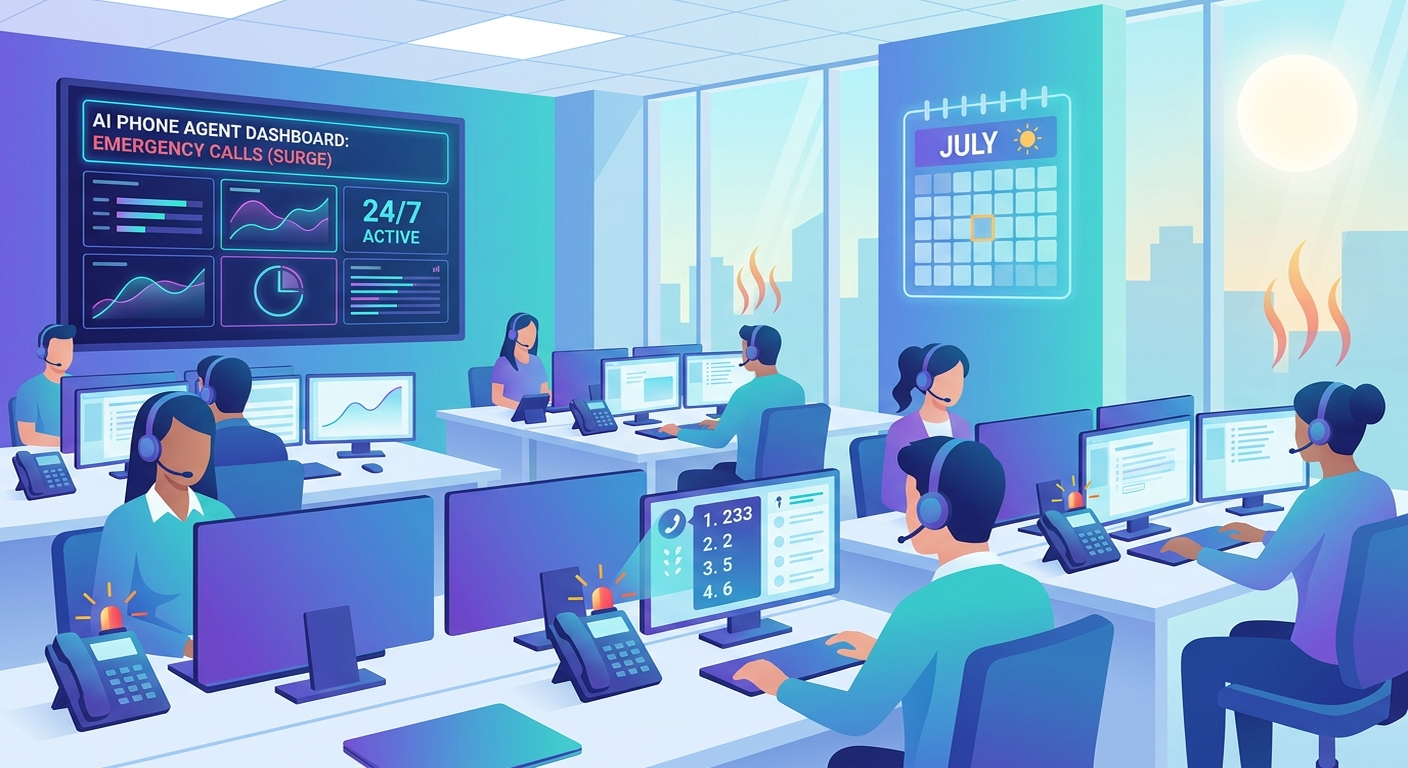
Every HVAC and plumbing operator in Oklahoma knows the feeling: the moment in late June when the phones start ringing differently. Not the steady trickle of spring tune-ups and quote requests. The summer surge — a flood of "my AC just died," "no cool air," "water heater leaking," "sewer backing up" calls that hits hardest between 4 PM and 9 PM, when homeowners get home from work and discover what's broken.
Industry data confirms what every dispatcher already knows: HVAC call volume jumps 30–50% from June through August, with the highest spike on the first 95°F+ day of the year. Plumbing demand climbs 15–25% over the same window, driven by irrigation line breaks, water heater failures under peak load, and sewer backups after summer storms. The total call volume surge is real, it's predictable, and it's the single most important operational challenge a small-to-mid trades business faces every year.
The problem isn't the calls. The problem is that the calls arrive faster than a small team can answer them — and the calls you don't answer are the calls your competitors book instead. In 2026, the operators surviving the summer surge without burning out their staff (or hemorrhaging revenue to missed calls) are increasingly leaning on AI phone agents. Here's how it actually works on the ground.
The Math: What the Summer Call Surge Actually Costs
Let's start with numbers. For a typical 3-truck HVAC operation in Tulsa doing roughly $1.2M in annual revenue, the summer surge plays out like this:
If that operation normally handles 60 calls a week in spring and 90 in peak summer, the surge adds 30 extra calls a week — 120 over the four-week peak. If the office can answer 70% of those (and most small teams can't, especially during the 4–9 PM crush), the remaining 36 voicemails translate to roughly 30 lost callers who book elsewhere. At $500 average ticket, that's $15,000 in revenue that walked out the door in a single month — and that's the conservative estimate.
Industry-wide, missed calls cost the average 3–5 truck HVAC business between $126,000 and $189,000 per year. Summer is when the majority of that loss happens, because summer is when the call volume spike meets the staffing ceiling.
Why the Traditional Fixes Stop Working in July
Most operators have tried the obvious solutions. They don't work — or they work badly enough that the cost is almost as painful as the problem.
1. Hire more office staff
The math doesn't pencil out for a 3-truck operation. A full-time, fully-loaded dispatcher costs the business $40,000–$50,000 a year, but you only need the extra capacity for 8–12 weeks. You can't hire in May and fire in September without destroying morale and trust. So you either pay for capacity you don't need nine months a year, or you stay understaffed exactly when you can't afford to be.
2. Use an answering service
Outsourced answering services run $0.95–$2.75 per minute or $1.50–$4.00 per call, and most of them can't actually book the job. They take a message, text it to the on-call tech, and the tech has to call the customer back. By then it's 30 minutes later, the customer is frustrated, and you've given them time to dial your competitor. Add in the fact that your techs are already in attics and crawl spaces and the callbacks pile up.
3. Send everyone to the office phones (and lose field productivity)
Pulling a tech out of the field to answer phones is a double loss: the tech's hourly revenue disappears, and the call often still goes to voicemail because they're driving between jobs. It's the worst of both worlds.
4. Just accept the missed calls
Most operators do this. It works fine until you check the revenue line in September and realize the surge you were too busy to handle also buried the quarter.
How AI Phone Agents Handle the Summer Surge Differently
An AI phone agent isn't a chatbot, isn't an IVR menu, and isn't voicemail with a transcription. In 2026, the leading AI phone agents for trades are conversational AI that answers the phone, talks to the homeowner like a skilled dispatcher would, asks the right qualifying questions, books the job directly into your scheduling system, and texts the customer a confirmation — all in under 90 seconds, all without a human on your side of the call.
Here's what that looks like during a 100°F Tulsa heat wave in late July:
- Caller dials your office number at 6:14 PM. The AI picks up on the first ring, identifies itself as a representative of your company, and asks how it can help.
- Homeowner says "my AC stopped cooling two hours ago and it's 99 degrees in my house." The AI recognizes the emergency, asks for the address, asks if anyone in the home is elderly, infirm, or has medical conditions that make the heat dangerous (this is the kind of triage a junior dispatcher often misses), and confirms the customer's contact info.
- The AI checks your scheduling system in real time. It sees the next available emergency slot is tomorrow morning at 7:30 AM, and offers it. If the homeowner pushes back ("can't you send someone tonight?"), the AI offers to flag the job as high-priority and connect with the on-call tech for a callback within 30 minutes.
- The job is booked. The customer gets a text confirmation with the appointment time, the tech gets a push notification with the address and job notes, and the AI sends a follow-up text 30 minutes before the appointment. Total call duration: 2 minutes 14 seconds.
- Your dispatcher never touched the call. Your techs are still on jobs. Your office staff is doing the work that actually needs a human — not the 30th "my AC is out" call of the afternoon.
That single call recovery, multiplied by 20–40 calls a week during peak summer, is the difference between a $15,000 revenue leak and an additional $10,000–$20,000 booked in a month. The math is one-sided.
The Real 2026 Numbers: What AI Phone Capture Looks Like in Production
Industry data from operators running AI phone agents in summer 2026 shows consistent patterns:
Those aren't theoretical. The 40% emergency-call capture rate comes from operators who switched from "office staff + answering service overflow" to "AI phone agent + office staff for complex calls" in 2025 and 2026. The cost-per-call numbers are what 2026 industry surveys show across multiple platforms (Autocalls.ai, ServiceTitan's AI add-ons, Sameday AI, Vellum, Housecall Pro's voice agent, and Quantum Agent Labs deployments in Tulsa and Oklahoma City). The 72% customer satisfaction is a 19-point jump in four years, driven by faster pickup, shorter hold times, and the simple fact that 3 AM calls get answered the same way 3 PM calls do.
What the AI Can't Do (And Why That Matters)
An honest assessment: AI phone agents in 2026 are excellent at capture, triage, scheduling, and confirmation. They're not good at handling complex customer service disputes, walking someone through a tricky diagnostic decision, or de-escalating an angry caller who's been waiting on a callback. For those calls — usually 10–20% of total volume — you still need a human.
That's why the operators getting the best results in 2026 aren't going "AI only." They're running a hybrid:
- AI handles: First-ring pickup, emergency triage, appointment booking, lead capture, after-hours overflow, FAQ answering, Spanish-language calls, weekend calls, holiday calls.
- Humans handle: Complex scheduling changes, upset customers, technical troubleshooting, insurance claim coordination, commercial client relationship management.
The result: the office staff stops being the bottleneck. They get to focus on the calls that actually need a human, and the AI absorbs the rest — including the 4 PM to 9 PM summer crush when the phones don't stop ringing.
What Tulsa Operators Are Seeing in Summer 2026
Local data is harder to pin down (the trades industry doesn't publish granular regional reports), but anecdotally — and from our own deployments in the Tulsa metro — operators using AI phone agents are reporting:
- Booking rate jumps of 25–45% in the first 60 days, driven almost entirely by calls that would have previously gone to voicemail during the 4–9 PM surge.
- Office staff retention improving, because dispatchers and CSRs stop spending 4 hours a day answering the same 30 emergency triage questions and start doing the work that actually uses their judgment.
- After-hours emergency capture becoming a real revenue line — the 7 PM to 7 AM calls that used to go to a third-party answering service are now being booked and dispatched directly, with the AI handling triage and the on-call tech getting a clean handoff via text.
- Spanish-speaking customer capture — and Tulsa has a growing Hispanic population — going from near-zero to a real channel, because the AI handles bilingual calls without needing a bilingual dispatcher on shift.
The Decision: Survive the Surge or Lose the Revenue
If you're a 3- to 10-truck HVAC or plumbing operator in the Tulsa metro, the summer surge isn't a question of whether you'll miss calls in July. You will. The question is whether those missed calls become:
- Voicemail that 85% of callers won't leave a message on, costing you $10,000–$20,000 in lost revenue per month.
- An answering service message that texts your tech, who calls back 30+ minutes later to a customer who already booked your competitor.
- An AI-handled booking that captures the emergency, schedules the job, and texts the customer a confirmation — for $0.40–$1.18 per call.
The third option didn't exist at scale two years ago. It exists now. And every operator who deploys it during the 2026 summer surge gets a permanent competitive advantage, because the customers they capture in July are the customers who call first in August, in September, and for every emergency after that.
You don't have to choose between AI and your office staff. You have to choose between absorbing the summer call surge with the tools that exist in 2026, or losing the surge to the operator down the street who already has.
Survive the 2026 Summer Surge
Quantum Agent Labs builds AI phone agents for Tulsa and Oklahoma City HVAC and plumbing operators. Capture every emergency call, book the job, and stop the summer revenue leak. No long-term contracts. Live in 7 days.
Get a Free Call Capture Audit