It happens faster than you can react. Your dispatcher schedules a routine AC tune-up for 10 AM. What they don't know: your technician already has an emergency call queued for the same slot at a location 25 minutes away. By the time you realize the conflict, both customers are frustrated, one technician is scrambling, and you're offering discounts to make up for the confusion.
For HVAC businesses in Tulsa and across Oklahoma, this scheduling nightmare is all too common. The PHCC's 2026 industry outlook confirms that labor shortages and operational inefficiencies remain top challenges for growing HVAC and plumbing shops. But there's a solution that's quietly transforming how the best-run shops operate: AI-powered scheduling and dispatch.
What AI Scheduling Actually Solves
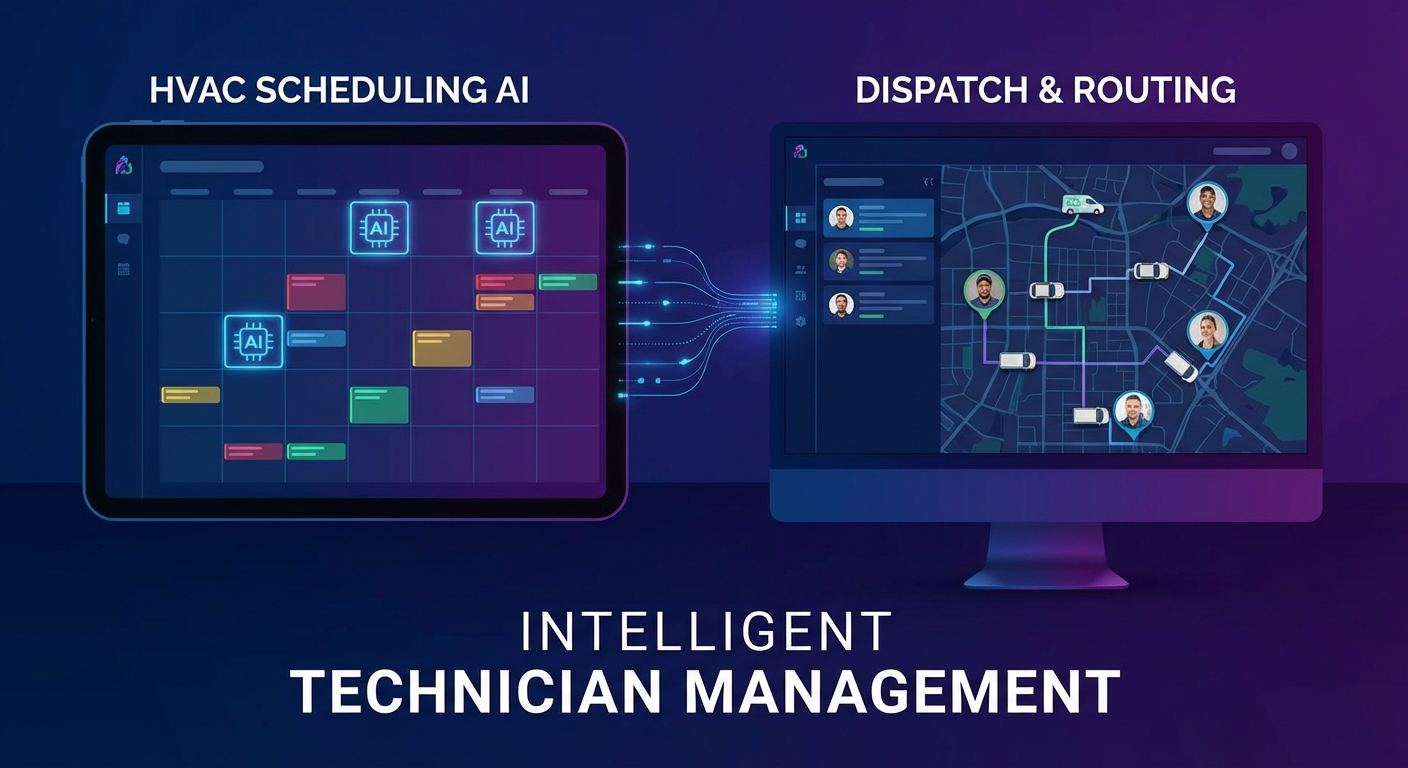
Modern AI scheduling isn't just a digital calendar. It's a dynamic system that understands your business constraints, technician capabilities, geographic territories, and real-time traffic conditions. Here's what that means in practice:
- Conflict Detection in Real-Time — When a new appointment comes in, AI checks technician availability, travel time between locations, and skill requirements before confirming the slot
- Smart Territory Management — Automatically assigns jobs to technicians based on geographic proximity, reducing fuel costs and drive time
- Dynamic Rescheduling — When emergencies arise, AI automatically finds the next best slot and notifies affected customers without human intervention
- Customer Communication Automation — Sends appointment confirmations, reminders, and ETA updates automatically
The Numbers Behind Scheduling Pain
Industry research shows that small HVAC businesses lose significant revenue to scheduling inefficiencies. Technician drive time between distant appointments eats into billable hours. Double bookings create chaos that spills over into customer service. And when dispatchers spend hours manually coordinating schedules, that's time not spent on revenue-generating service delivery.
How AI Dispatch Changes the Equation
Let's walk through a typical day with AI-powered scheduling versus traditional methods:
Traditional Flow (The Chaos Version)
- Customer calls at 8 AM requesting AC repair
- Dispatcher checks whiteboards, texts, and mental notes to find availability
- Schedules appointment without knowing about a conflict two towns over
- Technician discovers conflict at 9:30 AM, calls office
- Dispatcher spends 20 minutes reshuffling the day
- Both customers get late notices; one gets a discount for inconvenience
AI-Powered Flow (The Smooth Version)
- Customer calls at 8 AM requesting AC repair
- AI instantly checks all technician locations, calendars, and travel times
- Offers the customer three optimal slots based on real-time data
- Customer picks 10 AM; AI confirms and notifies the assigned technician
- AI sends customer SMS with appointment details and technician ETA
- When emergency comes in, AI auto-adjusts without human intervention
The difference isn't just efficiency—it's the elimination of stress for your dispatchers and technicians. Your team can focus on delivering great service instead of playing schedule Tetris all day.
What Tulsa HVAC Businesses Should Look For
When evaluating AI scheduling systems for your HVAC business, here are the features that actually matter:
Essential AI Scheduling Features
1. Real-Time Technician Tracking — Know where your techs are at all times, not just where they were scheduled to be
2. Traffic-Aware Routing — Google Maps integration that accounts for actual drive times, not just distances
3. Customer Self-Scheduling — Let customers book online during available windows without calling
4. Automated Reminders — Reduce no-shows with multi-channel reminder campaigns (SMS, email, voice)
5. Integration with Existing Systems — Plays nice with your current CRM, invoicing, and field service software
The ROI Is Stacked
Here's the math on AI scheduling investment: A typical 5-truck HVAC operation spends roughly 2-3 hours per day on scheduling coordination. At $25/hour for dispatcher time, that's $1,250-$1,875 per week in administrative overhead. An AI scheduling system typically costs a fraction of that while dramatically reducing errors and freeing your team for higher-value work.
Beyond direct cost savings, consider the revenue impact of:
- One additional service call per technician per day (from reduced drive time)
- Fewer no-shows from better customer reminders
- Higher customer satisfaction scores from accurate arrival times
- Reduced emergency scramble from better day-ahead planning
Most HVAC businesses see a complete ROI on AI scheduling within 60-90 days.
Getting Started
You don't need to rip out your existing systems to get AI scheduling benefits. Many solutions integrate with popular HVAC software platforms and can be running within a week. The key is starting: most businesses that implement AI scheduling wonder why they waited so long.
The best-run HVAC companies in Tulsa aren't the ones with the most trucks or the biggest marketing budgets. They're the ones whose operations run smoothly—and that starts with knowing where everyone is, when they're supposed to be there, and how to handle the inevitable changes without breaking a sweat.
AI scheduling isn't about replacing your dispatchers. It's about giving them superpowers.